
 Content Writer: Janice Chew • Thursday, 26/02/2026 - 23:11:40 - PM
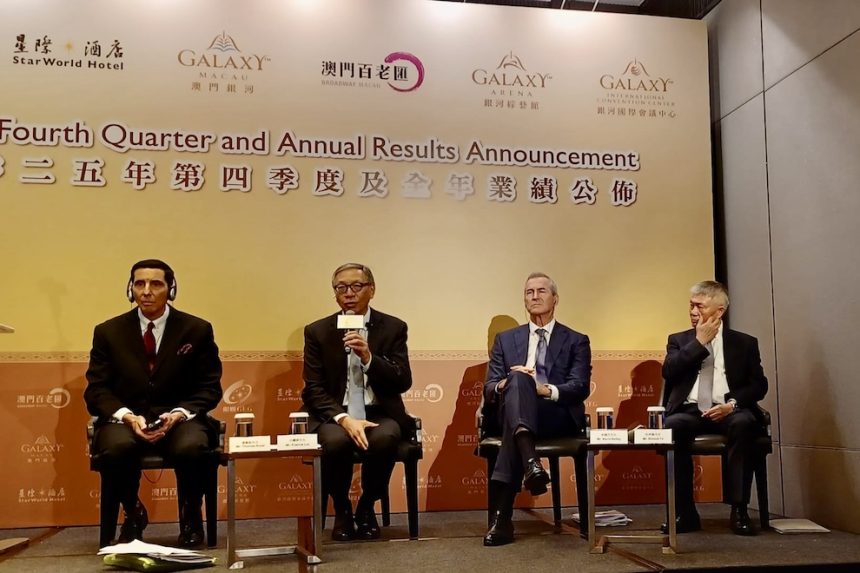
Macau heavyweight Galaxy Entertainment Group (GEG) is sending two strong signals to the market at the same time:
1️⃣ Its core business is generating serious cash again.
2️⃣ It is ready to look beyond Macau — with Japan described as “a very attractive proposition.”
Together, they form a bigger story: Galaxy may be positioning for its next growth cycle.
Financial Muscle: 4Q EBITDA Near US$550 Million
GEG reported fourth-quarter EBITDA approaching US$550 million, reflecting continued recovery momentum in Macau’s gaming and premium segments.
Key takeaways:
-
Strong mass-market recovery
-
Premium direct business holding up
-
Continued operational discipline
-
Final 2025 dividend flagged — signaling balance sheet confidence
In capital markets terms, dividends are not just payouts — they are statements. They say:
“We are comfortable with cash flow visibility.”
For a capital-intensive sector like integrated resorts, that confidence matters.
“Can We Step Onto the Global Stage?”
Francis Lui framed the strategic question clearly:
“In Macau we believe…that we are doing quite well, the question being whether we can step onto the global stage.”
This is not defensive expansion — it is expansion from strength.
He added:
“We always have that ambition, and in terms of capital [deployment], if there are good projects, we can work with the respective local governments and present to them our healthy balance sheet, giving them the confidence about our capacity for developing [a project].”
This is a calibrated signal to policymakers:
Galaxy is financially ready, disciplined, and capable of delivering large-scale IR developments.

Why Japan Stands Out
Japan remains one of the most attractive long-term IR markets:
-
Limited licenses
-
High-income domestic base
-
Strong regulatory structure
-
Long concession visibility
For a conservative operator like Galaxy, Japan aligns well with:
-
Premium mass expertise
-
Integrated luxury positioning
-
Balanced non-gaming strategy
-
Stable capital deployment
If structured correctly, Japan offers margin stability with lower junket dependency than Macau.
What About Thailand?
Lui also addressed Thailand — another frequently discussed IR prospect:
“Thailand for many years has been a good tourism country…but with the Bhumjaithai Party now in [a] leading position of the coalition government, I believe it will take a few years for [casino resort development] talks to return to the table.”
This comment reflects Galaxy’s pragmatic approach:
-
Thailand = long-term optionality
-
Japan = nearer-term structured opportunity
Galaxy appears selective rather than opportunistic.
The Bigger Picture: Diversification Without Urgency
This is not expansion out of weakness.
It is strategic diversification:
-
Reduce geographic concentration risk
-
Broaden earnings exposure
-
Improve valuation narrative among global investors
-
Strengthen policy and currency diversification
By maintaining dividends while discussing overseas growth, Galaxy signals that expansion would not come at the expense of financial stability.
Strategic Outlook
Galaxy’s current position can be summarized as:
Cash-generative. Selective. Ambitious — but disciplined.
Francis Lui’s remarks indicate a company comfortable at home in Macau, yet aware that long-term growth may require stepping beyond it.
The question now is not whether Galaxy has the capacity.
It is whether the right overseas framework — particularly in Japan — will align with Galaxy’s conservative capital philosophy.
If it does, one of Macau’s strongest operators may soon transition from regional leader to global IR contender.